
World Day for Safety and Health at Work : Otilus as a response to mental health.
April 28, World Day for Safety and Health at Work: what if Otilus were the French answer to the mental health crisis in the workplace ?
Tuesday April 28, 2026
April 28: what if workplace safety started with your tools?
Every year on April 28, the :contentReference[oaicite:0]{index=0} highlights a critical issue: safety and health at work.
For a long time, this topic was approached from a physical risk perspective. But in 2026, reality has profoundly changed. The danger has become less visible, more diffuse, and often underestimated: it is now mental.
Burnout, information overload, cognitive fatigue… Psychosocial risks have become one of the leading causes of long-term sick leave in France. A silent yet massive shift that directly challenges the way we work.
In response, companies are taking action. They invest in well-being programs, offer training, and support their teams. Yet one question is rarely asked: what if the problem also came from the tools used every day?
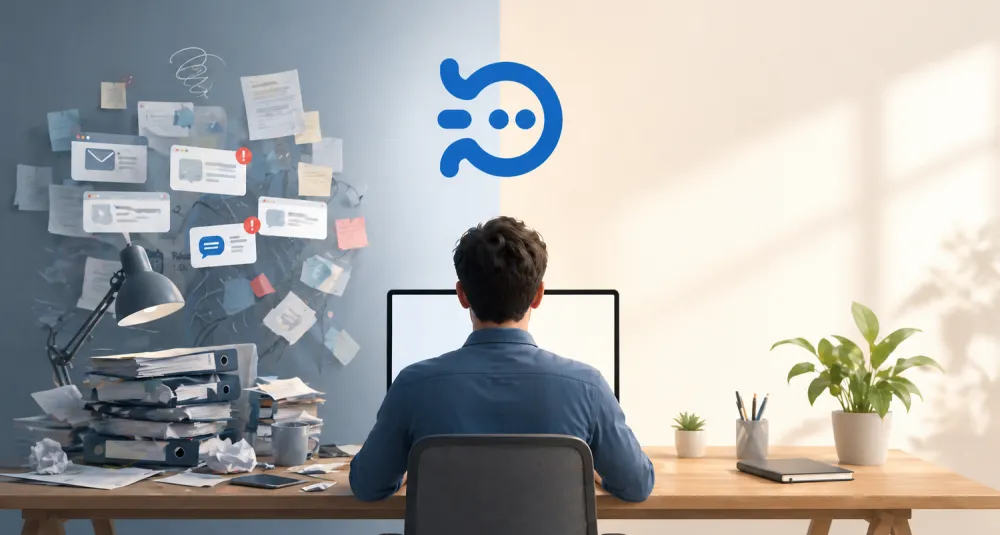
Because professional digital tools, originally designed to simplify work, have often become a source of complexity. A multiplication of interfaces, continuous notification flows, scattered tasks… Users are left to constantly sort, decide, and reconstruct meaning. An invisible but constant burden that leads to exhaustion.
This is precisely where Otilus offers a different approach.
While most tools keep adding features, Otilus made a different choice: to start again from how the human brain actually works. The idea is simple, yet rarely applied: a work tool should not only organize tasks — it should reduce the mental effort required to manage them.
In practical terms, this translates into a way of structuring work that limits unnecessary decision-making, immediately clarifies priorities, and prevents information overload. Users no longer have to search for what matters or rebuild the big picture — it is given to them.
This approach is based on principles of cognitive psychology, as well as research conducted with :contentReference[oaicite:1]{index=1}, with the goal of designing an interface aligned with natural mechanisms of attention and understanding. The objective is not to do more, but to make clarity accessible.
This positioning also fits into a broader context. At a time when most professional tools are designed outside Europe, digital sovereignty becomes inseparable from workplace well-being. Choosing a tool also means choosing a model: one based on transparency, data control, and a certain vision of responsibility.
Otilus claims a clear positioning.
Designed, developed, and hosted in France, it operates within a demanding European framework, particularly regarding data protection. But beyond that, it reflects an overall coherence: offering a tool that respects both users and organizations.
This human-centered approach also extends to cognitive diversity. A significant portion of the workforce operates differently, whether due to attention disorders, dyslexia, or visual specificities. Once again, this is often overlooked by traditional tools. Otilus takes the opposite approach, integrating these realities from the very beginning of its design, to create a work environment that is clearer, more predictable, and more inclusive.
This April 28, the question deserves to be reframed. It is no longer just about protecting employees from visible risks, but about rethinking the very conditions in which they work.
What if workplace safety no longer relied solely on corrective actions, but on tools designed from the start not to generate overload?
In a context where performance is often seen as opposed to well-being, Otilus offers another path: one of clarity, control, and long-term sustainability. Because a tool can organize work — but if well designed, it can also protect the people doing it.