
Project management tool : the features that are actually used
Fewer forgotten tasks. Less confusion. Fewer unnecessary meetings. More visibility. More action.
Monday June 08, 2026
Kanban, Gantt, GTD, Eisenhower matrix, Scrum, automations, scenarios, dashboards…
There is no shortage of methods and features.
But for a small or medium-sized business, the real question is not:
“Which tool does the most?”
The real question is:
“Which tool will the team actually use?”
Because project management software can look very powerful on paper. But if it is not adopted by the team, it simply becomes another source of mental load.
Project management: many methods, little real adoption
Companies talk a lot about Agile, Scrum, Kanban and productivity. And the numbers confirm it: according to the 17th State of Agile Report by Digital.ai, 71% of respondents use Agile in their software development lifecycle.
But behind this massive adoption, satisfaction is more nuanced. The same report indicates that only 11% of respondents using Agile say they are “very satisfied”. It also states that 34% of organizations create their own framework or do not follow any imposed framework.
In other words: companies do not necessarily want to apply a pure method. They are mostly looking for an organization that works in real life.
The same can be said about Scrum. According to the Agile Survey 2024 by PwC Luxembourg, 78% of companies that have implemented Agile use Scrum. Scrum therefore remains a very popular framework. But popular does not always mean easy to deploy.
Scrum: powerful, but often too heavy for small teams
Scrum can be very effective in trained, stable teams used to Agile rituals: Product Owner, Scrum Master, sprint planning, daily meeting, review, retrospective.
But in a small or medium-sized business, reality is often different. Roles overlap. Priorities change quickly. Team members wear several hats. And nobody wants to spend more time managing the method than moving projects forward.
The debate around Scrum is far from anecdotal. In an article published on iiSM.org, Gene Bond and Gandalf Hudlow state that Agile Scrum would work properly for only 15% of the teams that use it. In other words, according to their interpretation, 85% of teams would struggle to get the expected benefits from it.
This figure is deliberately strong and should be read as a critical point of view. But it highlights a real issue: a method is worth nothing if it is not understood, adapted and adopted by the team.
For a small or medium-sized business, the right approach is therefore not to copy a complex method to the letter. It is to choose a simple project management tool, visual and structured, that the whole team can actually use.
Kanban: the visual method teams understand quickly
The success of Kanban lies in its simplicity. You can instantly see what needs to be done, what is in progress, what is blocked and what is completed.
No long user manual required. Work becomes visible. And for a small or medium-sized business, this visibility is often the first lever of efficiency.
But classic Kanban also has its limits. In many tools, every task becomes a card. The board fills up, columns overflow, and the team gradually loses the overall view.
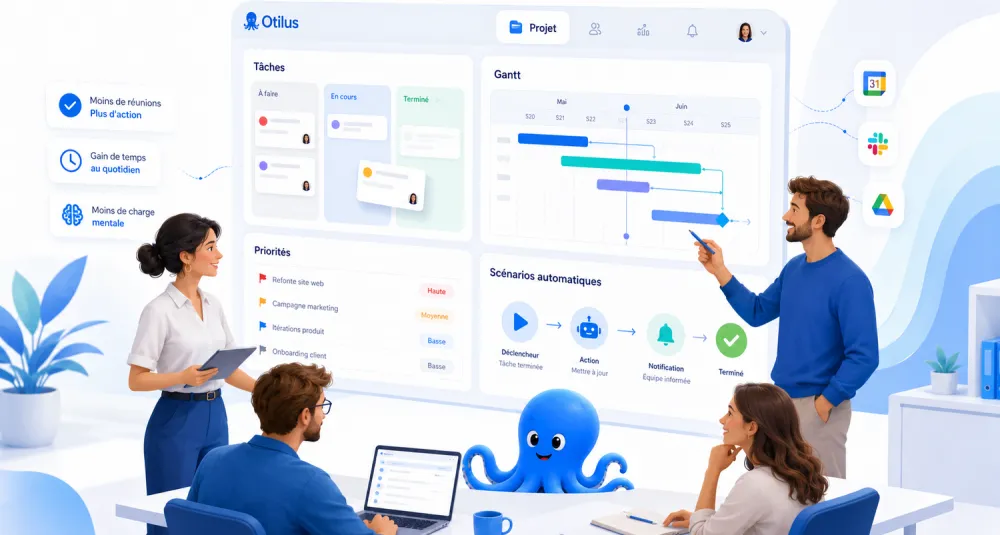
This is where Otilus rethinks Kanban. In Otilus, cards represent projects. Tasks live inside projects.
As a result, the team keeps a clear view of the activity without losing operational detail. This approach is particularly well suited to small businesses, SMEs, agencies, craftsmen, consulting firms, marketing departments and project teams.
Gantt: essential for seeing time
The Gantt chart is not always the tool people open every morning. Yet it remains essential for understanding something that Kanban shows less clearly: time.
Kanban shows progress. Gantt shows deadlines, milestones, sequences and workload periods.
For an SME, this is very useful when several projects need to be followed in parallel: a construction project, a marketing campaign, a client service, a website redesign, a recruitment process or an event.
The mistake would be to oppose Kanban and Gantt. They answer complementary needs.
Otilus combines a clear project view with a more structured timeline view. You can discover this approach on the pages dedicated to project organization and visual planning.
GTD and Eisenhower: useful, but rarely well integrated
The GTD method, for Getting Things Done, is based on a simple idea: getting things out of your head and into a reliable system.
For a business owner or manager, this is essential. A large part of mental load comes from having to remember everything: emergencies, follow-ups, decisions, tasks, deadlines and pending projects.
The Eisenhower matrix helps distinguish what is urgent, important, secondary or delegable. It prevents teams from confusing busyness with efficiency.
The problem is that these methods often remain theoretical. They are known, sometimes quoted, but rarely integrated naturally into the daily work tool.
Otilus makes this logic more concrete through an approach focused on tasks, priorities and action. The goal is not to add yet another method. The goal is to help everyone know what to do now.
To go further, see the pages on prioritization and reducing mental load.
Automatic scenarios: useful automation, not a factory of complexity
Automation has become an essential keyword in project management tools. But for a small or medium-sized business, it must never turn into a complex machine.
Good automation should not make work more complicated. It should prevent mistakes, secure key steps and trigger the right actions at the right time.
Automatic scenarios are particularly useful for recurring projects: client files, construction jobs, recruitment processes, campaigns, training sessions, services, internal approvals or sales actions.
- Automatically create tasks when a project reaches a specific stage.
- Notify the right person at the right time.
- Add a reminder before a deadline.
- Standardize a recurring process.
- Prevent an important step from being forgotten.
- Save time on repetitive projects.
This is exactly the purpose of automatic scenarios in Otilus. They automate the right habits without drowning the team in incomprehensible settings.
Truly useful automation is not the one that impresses. It is the one that makes daily work lighter.
Features that are often highlighted, but rarely used
Many project management software platforms communicate around advanced features. But in a small or medium-sized business, not all of them are actually used on a daily basis.
| Feature or method | Real use in a small or medium-sized business |
| Full Scrum | Powerful in some contexts, but often too heavy for a small untrained team. |
| Complex dashboards | Attractive on paper, but rarely checked by the whole team. |
| Advanced reporting | Useful for management, but secondary if projects are not already well structured. |
| Very advanced automations | Powerful, but risky if they become impossible to understand. |
| Strict Agile frameworks | Often adapted, simplified or abandoned in real-world use. |
By contrast, the practices that last are often the simplest: seeing projects, understanding priorities, tracking tasks, anticipating deadlines and automating useful reminders.
The truly useful features for a small or medium-sized business
When choosing a project management tool for small and medium-sized businesses, it is better to focus on the features that truly improve daily work.
- A clear project view to know where the activity stands.
- A simple Kanban to visualize stages without heavy training.
- A readable Gantt chart to understand deadlines and milestones.
- Well-organized tasks inside each project.
- Visible priorities to prevent everything from feeling urgent.
- Automatic scenarios to make recurring processes more reliable.
- Useful notifications to alert without overwhelming the team.
- A project history to keep track of decisions and actions.
- Fast onboarding to encourage adoption by the whole team.
These features are at the heart of Otilus: task management, deadline tracking, team collaboration and simplified management.
The real criterion: team adoption
The best project management software is not the one that ticks the most boxes. It is the one that truly becomes part of the team’s habits.
A small or medium-sized business cannot afford to deploy a tool that nobody understands, nobody opens or that requires constant training.
Adoption must be fast. The interface must be readable. The benefits must be immediate.
In short:
if the tool requires too much effort to use, it will not reduce mental load. It will increase it.
This is why Otilus focuses on a visual, simple and structured approach: helping the team quickly understand where projects stand, what the priorities are, who needs to act and what comes next.
Otilus: keep what works, remove what drains the team
Otilus does not try to pile up features just to impress. It focuses on what truly works in project management: the clarity of Kanban, the timeline view of Gantt, the logic of GTD, Eisenhower prioritization and automatic scenarios.
All with one simple idea: a project management tool should help the team move forward, not require it to become expert in methodology.
For a small or medium-sized business, this is often where everything is decided. The company does not need a more complex tool. It needs a clearer one.
A tool capable of reducing forgotten tasks, avoiding unnecessary meetings, structuring projects, clarifying priorities and making information accessible to the whole team.
Conclusion: teams do not need more method, they need more clarity
Kanban, Scrum, Gantt, GTD, Eisenhower, automations, scenarios… All these approaches can be useful.
But for a small or medium-sized business, the question is not which method is the purest.
The real question is:
which method will actually be understood, used and adopted by the team?
This is where Otilus makes the difference. It keeps what truly works: the clear view of Kanban, the timeline view of Gantt, task prioritization, automatic scenarios and ease of adoption.
Not to add another layer of management.
But to make the organization smoother, clearer and more efficient.
Looking for a simple, French project management tool designed for the real needs of small and medium-sized businesses?