
Digital sovereignty: your SaaS tools matter just as much as your servers.
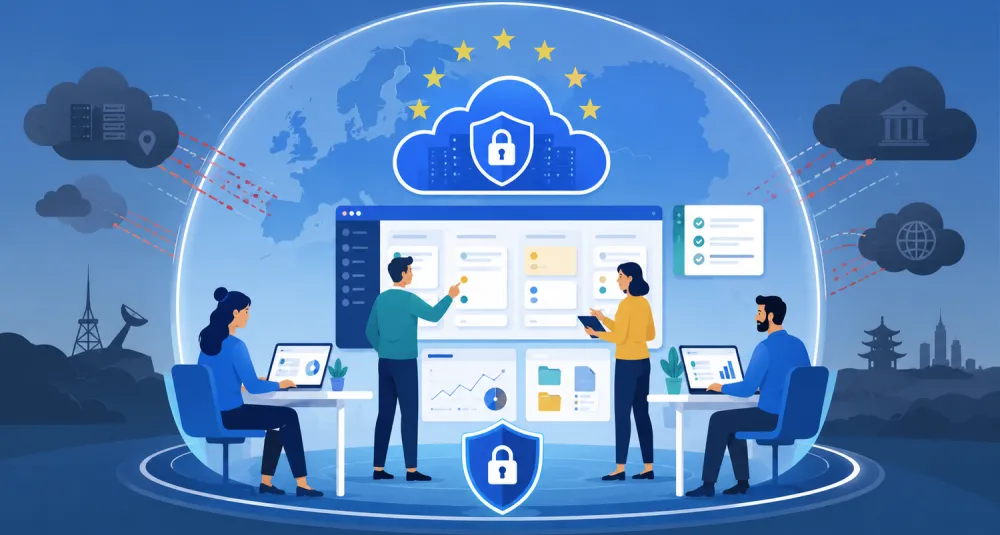
Digital sovereignty is often associated with data centers or servers. Yet in the day-to-day life of a business, it also comes down to much simpler choices: the SaaS software you use!
Monday July 27, 2026
SaaS has become the norm in business
Online software has profoundly changed the way work is organized. It can be accessed from a browser, does not always require installation, and helps teams collaborate more easily. It is practical, fast and often effective.
But this apparent simplicity hides an important reality: every SaaS tool hosts, processes or transfers data. According to Eurostat, 52.74% of European Union businesses were using paid cloud services in 2025. The most common uses include emails, office software and file storage.
Cloud is no longer a topic reserved for large companies. It also concerns microbusinesses, SMEs, agencies, manufacturers, consulting firms, local authorities and field teams.
| Key figure | What it shows |
| 52.74% | More than one in two European businesses already uses paid cloud services. |
| Around 15% | According to Synergy Research Group, European providers represent only a limited share of the European cloud market. |
| 4.4 million dollars | According to IBM, this is the estimated global average cost of a data breach in 2025. |
A project management SaaS tool contains sensitive data
A project management board may seem ordinary. Yet it can contain highly strategic information:
- the names of important clients or prospects;
- delivery deadlines;
- internal bottlenecks;
- each team member’s responsibilities;
- documents linked to a project;
- commercial priorities;
- the company’s working methods;
- decisions made as a team.
This data is not just a list of tasks. It tells the story of what the company is preparing, what it is selling, what it is delaying, what it is prioritizing and what it is building.
This is why a sovereign project management tool is not just a technical choice. It is a choice of control.
It is not only about GDPR
Many companies think everything is settled as soon as a software provider displays a GDPR statement. It is an essential foundation, but it is not the whole issue.
The CNIL reminds us that data transfers outside the European Union must be regulated and must guarantee an adequate level of protection. ANSSI also highlights that the SecNumCloud qualification is aimed at trusted cloud services, recommended for protecting sensitive data.
Digital sovereignty therefore goes further than compliance. It raises a simple question: who truly controls the environment in which your data circulates?
Why the SaaS tools you use really matter
Every software subscription creates a dependency. Sometimes a light one. Sometimes a deep one. When a tool becomes central to the organization, switching solutions can become difficult: scattered data, established habits, limited export formats, multiple integrations, incomplete history.
The real risk is not only paying too much. The real risk is no longer knowing where your company’s essential information lives.
| Question to ask | Why it matters |
| Where is the data hosted? | To understand the actual legal and technical framework. |
| Who publishes the software? | To understand economic and regulatory dependencies. |
| Which subcontractors are involved? | To identify data flows and associated risks. |
| Can you easily retrieve your data? | To avoid being locked into a tool that has become essential. |
| Does the tool remain simple for teams? | Because a sovereign tool that is unusable will not be adopted. |
Sovereignty should not make work more complicated
Choosing a sovereign tool should not mean going backwards. A company needs software that is clear, collaborative, visual and effective. It also needs a tool that teams can understand quickly, without heavy training or a pile-up of unnecessary features.
This is precisely Otilus’s approach: to offer a French and European solution designed to organize work without making it more complicated. With its reimagined Kanban, Otilus does not turn every card into a simple micro-task. A card represents a project, with its tasks, deadlines, notes, documents and history.
Automatic scenarios then make it possible to structure the company’s working methods: the right tasks appear at the right time, responsibilities become clearer and oversights are reduced.
Digital sovereignty then becomes a concrete lever: less dispersion, less dependency, more clarity.
An economical choice too
Digital sovereignty is sometimes presented as a luxury. It does not have to be. A French and European solution can also be clearer economically, especially when it avoids stacked options, paid extensions or pricing tiers that are difficult to compare.
With Otilus, the goal is simple: to bring together the essential features in a clear tool that can be used every day, without complicating the experience. Project management, tasks, Gantt, scenarios, archives, notifications, calendar and teamwork can all be designed together, within the same environment.
To explore this topic further, you can also read the article Project management and digital sovereignty: your data in Europe.
Conclusion: SaaS is also a strategic choice
Digital sovereignty is not only played out in major technological debates. It is played out in the tools we open every morning, in the projects we track, in the documents we share and in the decisions we entrust to online platforms.
A SaaS tool is never neutral. It can strengthen your control, or increase your dependency. It can clarify your organization, or scatter your information. It can protect your working memory, or entrust it to ecosystems you do not really control.
By choosing Otilus, you choose a French and European solution designed to structure projects, reduce mental load and keep your data within a framework that is consistent with the challenges businesses face today.
Digital sovereignty is not a brake on performance. It is a more responsible, more sustainable and more clear-sighted way to work.