
Vendor lock-in: Otilus champions your freedom
Switching software should never mean losing your projects. Learn about vendor lock-in, the Data Act and Otilus’s commitment to data portability.

Thursday November 05, 2026
Project management software should help you move forward, not prevent you from leaving. Yet over the years, businesses accumulate tasks, documents, decisions, schedules and much of their collective knowledge within these tools. When they decide to switch solutions, the question becomes very practical: can they retrieve their information in a format they can actually use?
This dependency has a name: vendor lock-in, sometimes also referred to as supplier lock-in or “vendor blocking”. At Otilus, we advocate a different approach: choosing a tool for the value it provides, rather than because leaving it has become too complicated.
🔒 What exactly is vendor lock-in?
Vendor lock-in occurs when an organisation becomes so dependent on a provider that switching software becomes expensive, risky or technically difficult. It does not necessarily involve a contractual restriction. Lock-in can go unnoticed in everyday use and only become apparent when it is time to migrate.
There are generally three forms of dependency:
- Technical: data is stored in a proprietary format that is difficult to convert or import into another system.
- Organisational: teams, processes and automations are closely tied to a particular software application.
- Economic: the costs of leaving, training staff or rebuilding the setup are high enough to discourage switching.
Imagine a company managing 300 projects on a platform. It can download a list of tasks, but not their connections to phases, documents, assignees and activity logs. Its data still exists, of course. It just needs to reconstruct the context, project by project. The “Export” button does not always work miracles.
💵 Stable pricing to protect your freedom
Vendor lock-in can also be economic. When an entire organisation depends on a software application, switching providers becomes costly. A price increase can then leave the business facing a difficult choice: accept the increase or undertake a migration that takes time and resources.
Otilus applies a strict policy of no price increases for the same plan and number of users. Software improvements and new features are part of this commitment to pricing stability. You can build your organisation with greater budget predictability, without worrying that your growing reliance on the tool will be used as leverage to raise prices.
This approach forms part of a broader reflection on sovereignty and business continuity. A potential “kill switch”, meaning the disabling of access to a service by a provider or at the direction of a third party, is a separate risk. Preventing it also requires control over technical dependencies, planning for service continuity and making provision for data retrieval.
Predictable pricing, control over your data and the freedom to choose: these are the principles that should guide a lasting relationship with your software provider.
Why the risk increases with the cloud
According to Eurostat, in a publication dated 3 February 2026, 52.7% of European Union enterprises with at least 10 people used paid cloud services in 2025, an increase of 7.4 percentage points compared with 2023. Among enterprises using these services, 85.2% used them for email and 71.5% for file storage.
💡 Key takeaway: digital sovereignty is about more than where data is hosted. It also means knowing who controls the data, how it is protected and how to retrieve it.
🇪🇺 The EU Data Act changes the rules
The European Union has identified this risk. The Data Act, the EU regulation on data, has largely applied since 12 September 2025. Among its aims are making it easier to switch providers of data processing services and reducing technical, contractual and financial barriers. The European Commission explains these provisions in its overview of Chapter VI.
Subject to the conditions set out in the regulation, it covers cloud services and certain software applications delivered as SaaS. For the software and platform providers concerned, it requires open interfaces and, at a minimum, data exports in a commonly used, machine-readable format.
Another important milestone: from 12 January 2027, the switching charges covered by the regulation must be removed. This change is set out in Article 29 of Regulation (EU) 2023/2854. It does not mean that every migration will be free: importing data into a new provider’s system or carrying out integration work can still require effort.
The Data Act does not require two very different software applications to offer exactly the same features, either. Exporting data and immediately recreating a fully operational setup in another application are two separate objectives.
✅ An essential principle: portability is not a favour granted by a software provider. It is becoming a matter of software design, contractual transparency and, depending on the service concerned, regulatory obligations.
📤 Exporting data is not always enough
To understand the problem, consider a project with five phases, twelve tasks, several attachments and three team members. An export that only includes task titles preserves a list. It does not necessarily allow you to rebuild the project.
Meaningful portability therefore needs to address several levels:
- the list of projects and how they are organised into boards;
- progress phases and deadlines;
- tasks, subtasks and priorities;
- team members and their assignments;
- documents, notes and comments;
- activity logs and relationships between items.
Otilus: what is available today
Otilus is project management software developed in Amiens, France, with business data hosted in France. Its approach to digital sovereignty is based on control over the working environment and a relationship of trust with the organisations that use it.
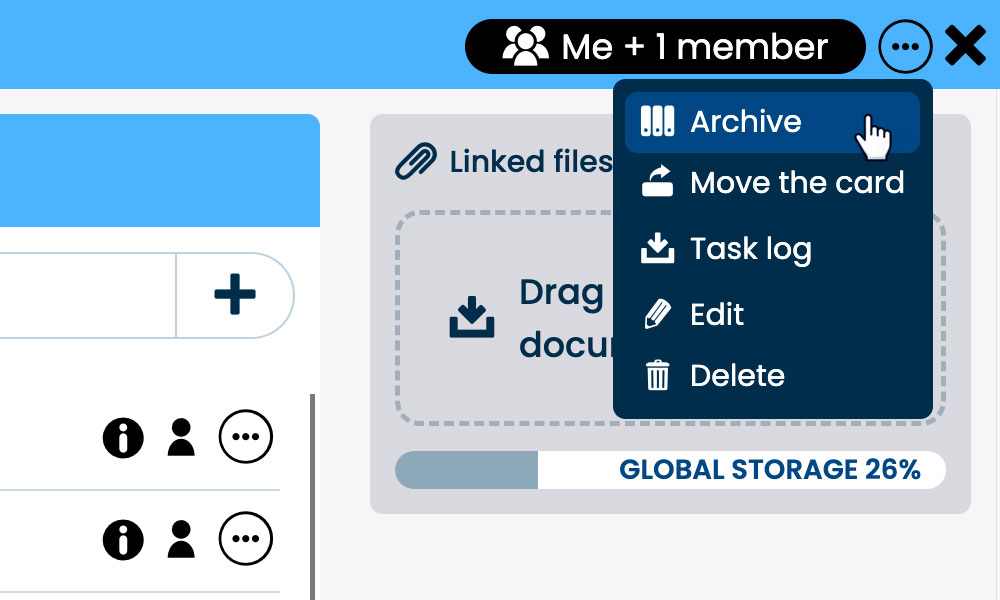
This ambition is already supported by practical features. In Otilus’s visual organisation boards, a card represents a complete project: phases, actions, responsibilities and deadlines are brought together within a consistent structure. Teams gain a shared view of their work.
Otilus also lets you export a project’s task log in CSV format. This history can be retained and analysed independently of the application. The project archiving system, meanwhile, makes it easier to view and restore cards within Otilus.
But let us be precise: a CSV export of the task log is not yet a complete, universal export of an entire workspace. Restoring an archived card in Otilus is also different from transferring that card to a third-party application.
This is precisely why vendor lock-in deserves an open discussion. Promising complete freedom without a verifiable migration mechanism would contradict the stated objective.

The next step: planning for full portability
To take this approach further, several technical options deserve consideration. They are possible directions, not export or import features that are already available:
- A full export: retrieve boards, projects, tasks, deadlines, notes and relationships in a structured archive.
- Documented formats: use CSV for tabular data and JSON to preserve richer structures, depending on requirements.
- A data dictionary: explain fields, identifiers, statuses and relationships to make the data easier to reuse.
- File retrieval: bring together exportable attachments and preserve their links to the relevant projects.
- Gradual development of import capabilities: explore importing data from other project management tools, with explicit field mappings.
There is no universal format that automatically preserves every application’s specific characteristics. However, open standards, readable exports and clear documentation greatly reduce dependency. A realistic migration can therefore identify which items transfer automatically, which need to be adapted and which require human intervention.
Proprietary software and the freedom to leave: are they compatible?
Yes. Proprietary software does not necessarily mean locked-in software. And open-source software does not automatically make migration easy. What matters includes access to data, documentation, the formats used, contractual terms and the ability to switch providers.
Otilus is a proprietary solution. Its approach to sovereignty therefore does not need to claim that it is open source to support portability and the freedom to switch providers. Instead, it must be based on practical, verifiable capabilities that are expanded over time.
This distinction complements our thinking on project management and digital sovereignty. It also connects with the issues discussed in our article on corporate digital responsibility: choosing a provider also means choosing the level of dependency you are willing to accept.
How can you assess vendor lock-in before choosing a solution?
| Question to ask | What to check |
|---|---|
| What can be exported? | Projects, tasks, files, comments, activity logs and metadata. |
| In which format? | CSV, JSON or another documented, reusable format. |
| Who initiates the export? | The customer or the support team, and under what conditions? |
| How much does leaving cost? | Any charges, migration services and contractual timeframes. |
| Can you test a migration? | Import a sample into another environment and check the data. |
FAQ: vendor lock-in, the Data Act and Otilus
Is vendor lock-in illegal?
Not in itself. However, certain contractual or technical practices may be subject to European law, particularly where the Data Act’s provider-switching obligations apply.
Does the Data Act require CSV exports?
No. For the services concerned, the regulation refers in particular to commonly used, machine-readable formats. The choice of format depends on the nature of the data and the applicable obligations.
Can you already transfer everything from Otilus to another application?
The CSV export of the task log is available. However, it should not be confused with a complete migration of all boards, documents, settings and automations. That capability requires a specifically defined technical scope.
💙 Our belief: customers should stay by choice
A project management tool must earn its users’ trust every day through its usefulness, clarity, reliability and ability to evolve. It should not rely on migration difficulties to retain them.
At Otilus, we advocate structured, sovereign project management developed in France. Tackling vendor lock-in is part of that ambition. It requires a clear distinction between features already available, such as task log exports, and more comprehensive portability mechanisms that still need to be designed and documented.
The strongest loyalty does not come from a locked door. It comes from wanting to stay.