
The Entrepreneur’s Mental Load: How to Regain Control with Otilus
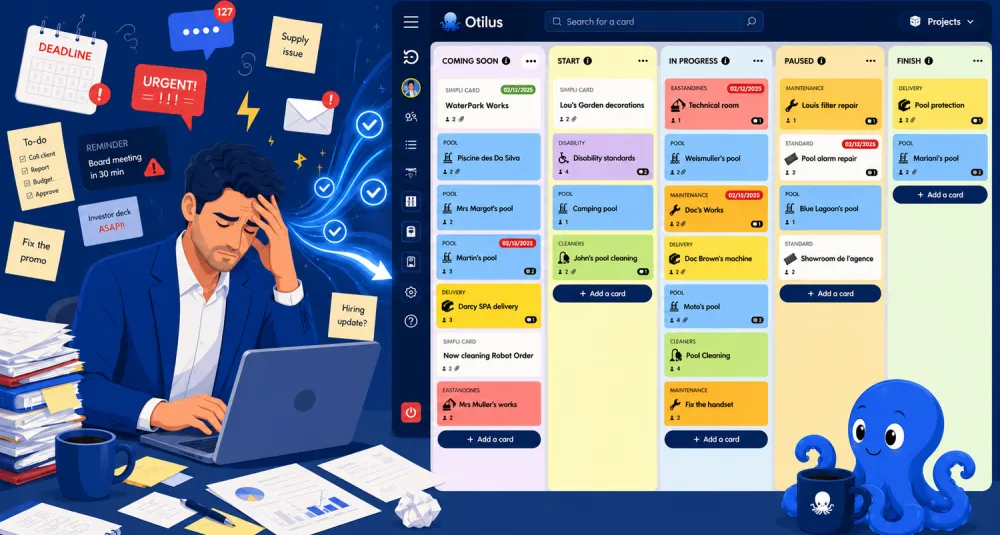
Running a business is not just about managing projects. It also means keeping track of emergencies, follow-ups… This invisible pressure has a name: mental load.
Monday July 06, 2026
It increases when information is scattered, when projects lack clarity, and when the business owner unintentionally becomes the living memory of the organization.
According to EU-OSHA, nearly 45% of European workers report being exposed to risk factors that may harm their mental health. The European agency also points out that stress, anxiety and depression are the second most common work-related health problem in Europe.
The issue is therefore not only individual. It is also organizational: when work is not clearly visible, the brain has to compensate.
Mental load often comes from a lack of visibility
In a company, mental load increases as soon as important information is scattered across emails, meetings, files, messages and verbal exchanges.
The business owner ends up following up, checking, rephrasing, reminding people of priorities and mentally reconstructing the progress of each case.
European figures show that this pressure is structural. In 2025, Eurofound indicates that 57% of European respondents are at risk of depression according to the WHO-5 indicator. For its part, EU-OSHA reports that more than 40% of workers experience strong time pressure.
In other words: the less clear the organization is, the greater the mental pressure becomes.
The real hidden cost: coordinating instead of moving forward
Mental load does not only come from the amount of work. It also comes from the time spent looking for information, checking progress, synchronizing teams and making sure nothing has been forgotten.
According to Asana’s international Anatomy of Work 2023 study, employees spend an average of 58% of their day on “work about work”, meaning coordination work rather than their real value-added work.
For a business owner, this translates very concretely into:
- meetings to find out where projects stand;
- follow-ups to check whether a task has been completed;
- exchanges to retrieve a piece of information;
- emergencies created by a lack of anticipation;
- decisions delayed by a lack of visibility.
Globally, the observation is the same: Gallup notes that employees’ daily stress remains higher than its pre-pandemic level. Modern work therefore requires tools that reduce uncertainty, not just add more task lists.
Why Otilus’s project-oriented Kanban helps reduce mental load
In many Kanban tools, a card represents a task. This is useful for tracking simple actions, but it quickly becomes limited when you need to manage complete projects.
With Otilus, Kanban is reimagined: a card represents a project, a file, a mission or a client request. Tasks, notes, documents, deadlines and history are then grouped inside that card.
This logic changes everything when it comes to mental load. Instead of seeing an accumulation of small isolated tasks, the business owner can visualize all their work at a glance: ongoing projects, their phase, their priority and any potential blockers.
| Classic Kanban | Project-oriented Kanban with Otilus |
| One card = one task | One card = one complete project |
| Fragmented view | Global view |
| Context is scattered | Context stays inside the card |
| The business owner has to reconstruct progress | Progress is immediately visible |
What was unclear in your head becomes clear on screen. This global visualization is precisely what helps reduce mental load.
Regain control without micromanaging
Regaining control does not mean monitoring everything. It means having a clear view so you can make the right decision at the right time.
With Otilus, projects move forward through readable phases. Responsibilities are more clearly identified. Priorities are easier to understand. Important tasks no longer remain only in the business owner’s head.
Otilus also allows you to go further with methods such as GTD and the Eisenhower Matrix, to better distinguish what is urgent, what is important, what can wait and what can be delegated.
With the Gantt chart, the business owner can also anticipate deadlines and identify potential delays earlier.
Less uncertainty, fewer oversights, more visibility
Mental load does not disappear with a simple task list. It decreases when the organization becomes visible, shared and reliable.
Otilus helps take projects out of the business owner’s head and make them readable for the whole team. Each card becomes a point of reference. Each phase gives a clear indication. Each task finds its place within a broader project.
This approach makes it possible to move from an organization based on memory to an organization based on visibility.
Less uncertainty. Fewer oversights. Fewer unnecessary meetings. More visibility. More action.
Discover Otilus
If you feel like you have to remember everything, follow up on everything and check everything, it may be time to change the way you manage your projects.
Otilus helps you visualize your projects, structure your priorities and regain control without making your organization heavier.